

Designer (1)

America’s Water Systems Are Under Attack. Are We Paying Attention?

For years, cybersecurity professionals have warned that critical infrastructure would become a primary target for cybercriminals and nation-state actors. Unfortunately, we are now watching that prediction play out in real time.

In recent days, federal authorities reported cyberattacks targeting municipal water and wastewater systems across at least seven U.S. states. Some utilities were forced into manual operations, and more than 30 community water systems in Minnesota alone were reportedly affected. Federal agencies have warned that these attacks have the potential to disrupt water operations and threaten critical public services. [nbcnews.com], [cbsnews.com]

While no widespread contamination has been reported, the message is clear: America’s water infrastructure remains a high-value target.

Why These Attacks Matter

When people think about cyberattacks, they often picture stolen data, ransomware demands, or financial losses. Critical infrastructure attacks are different.

Water treatment plants control systems that directly impact public health and safety. If attackers gain access to operational technology (OT), industrial control systems (ICS), or SCADA environments, they can potentially manipulate processes that regulate water pressure, chemical treatment, and distribution operations. Federal and state authorities have warned that disruptions to water system operations can create serious risks for communities. [techtimes.com], [nbcnews.com]

The consequences can include:

  • Service outages
  • Boil-water advisories
  • Emergency manual operations
  • Environmental impacts
  • Loss of public trust
  • Significant financial and regulatory costs

In many cases, operators have been able to intervene before severe damage occurred. However, the fact that attackers continue to gain access demonstrates an uncomfortable reality: many critical infrastructure organizations still have exploitable weaknesses. [wisdiam.com], [thehill.com]

A Dangerous Trend Is Emerging

What concerns me most is not a single attack. It is the pattern.

Over the last several years, we have seen repeated attempts to target water facilities, energy providers, pipelines, healthcare organizations, and municipal governments. In many cases, attackers are not relying on sophisticated zero-day exploits. They are finding internet-exposed systems, weak credentials, poorly segmented networks, and unpatched devices. [thehill.com], [wisdiam.com]

That should be a wake-up call.

Many organizations assume that because they have firewalls, antivirus software, or compliance requirements in place, they are adequately protected. Unfortunately, cybercriminals do not attack based on what organizations think is secure. They attack based on what is actually vulnerable.

The recent wave of water system attacks highlights just how attractive critical infrastructure has become. Whether the motivation is disruption, political influence, espionage, or preparation for future conflicts, the outcome is the same: organizations must assume they are potential targets.

The Critical Role of Penetration Testing

This is where penetration testing becomes one of the most valuable investments an organization can make.

A penetration test goes beyond automated vulnerability scanning. It simulates the tactics, techniques, and procedures that real-world attackers use to gain access to systems.

The goal is simple:

Find the weaknesses before the bad guys do.

For critical infrastructure organizations, penetration testing can help identify:

  • Internet-facing vulnerabilities
  • Weak authentication controls
  • Misconfigured firewalls
  • Insecure remote access solutions
  • Network segmentation failures
  • Privilege escalation paths
  • Vulnerabilities that expose operational technology environments

Most importantly, penetration testing provides leadership with a realistic understanding of risk rather than assumptions about security.

When an attacker discovers a weakness first, the organization pays the price.

When a penetration tester discovers it first, the organization has the opportunity to fix it.

Why Penetration Testing Should Be Part of Every Security Strategy

Cybersecurity is no longer just an IT issue. It is an operational issue, a business issue, and in the case of water systems, a public safety issue.

Organizations responsible for critical infrastructure should not wait for a federal warning, a breach notification, or a headline-making incident before evaluating their defenses.

Security assessments, vulnerability management, employee awareness training, incident response planning, and penetration testing should all work together as part of a comprehensive cybersecurity program.

The organizations that fare best during cyber incidents are usually the ones that identify and address weaknesses before attackers have the opportunity to exploit them.

How Firma IT Solutions Can Help

At Firma IT Solutions, penetration testing is more than checking a compliance box. Our approach is designed to think like an attacker, identify real-world risks, and provide organizations with actionable recommendations that strengthen security.

We help organizations uncover vulnerabilities across external networks, web applications, cloud environments, and internal infrastructure before those weaknesses become headlines.

The recent attacks against water systems across the United States should serve as a reminder that critical infrastructure remains under constant threat. The question is not whether attackers are looking for vulnerabilities. They are.

The question is whether your organization will find them first.

If your organization has not conducted a recent penetration test, now is the time to make it a priority. Your security strategy should not begin after an attack. It should begin long before one occurs.

Firma IT Solutions helps organizations identify weaknesses before attackers do. Contact us today to learn how our penetration testing services can help strengthen your cybersecurity posture and reduce risk.


ChatGPT Image Jul 21, 2026, 01_39_15 PM

The Ernst & Young Cyberattack: Why Third-Party Risk Demands Penetration Testing

Another major organization has learned a difficult lesson: a company can have strong internal security controls and still become the victim of a breach through a trusted third-party platform. The recent Ernst & Young data breach highlights the risks associated with such third-party vulnerabilities.

Ernst & Young LLP, better known as EY, recently began notifying clients that sensitive personal and financial information was stolen from a third-party information technology service management platform. EY used the platform to support employees performing tax-related work, and support tickets sometimes included documents containing client tax information.

According to EY’s breach notice, an unauthorized party accessed the platform between March 28 and April 12, 2026, and downloaded documents belonging to multiple clients. EY detected unusual activity on April 23, launched an investigation, secured the environment, brought in outside cybersecurity professionals, and notified federal law enforcement.

How Did the Attackers Get In?

EY has not publicly disclosed the initial attack method, the identity of the platform provider, or the attacker responsible. Therefore, it would be irresponsible to guess whether the breach began with stolen credentials, social engineering, an application vulnerability, a misconfiguration, or another technique.

What we do know is that attackers gained unauthorized access to a trusted platform and downloaded sensitive client documents.

That is the danger of third-party risk.

Attackers do not always have to break through your firewall. Sometimes they enter through a vendor, cloud platform, support system, software integration, or trusted account.

What Information Was Compromised?

The stolen documents contained personal and financial information used to prepare tax filings. Reported data included names, addresses, Social Security numbers, financial account numbers, credit or debit card numbers, and other tax-related information. EY has not publicly disclosed the total number of affected clients and has said it is not aware of misuse or additional exposure.

However, the absence of known misuse today does not mean the information has no value to criminals.

Tax records can give an attacker enough information to build a detailed profile of a victim. Criminals may use that data for identity theft, fraudulent tax filings, account takeover, targeted phishing, business email compromise, or convincing social engineering attacks.

Unlike a password, a Social Security number cannot simply be reset. Once this information leaves a protected environment, the risk can follow the victim for years.

A Third-Party Breach Is Still Your Breach

The EY incident reinforces a truth every organization must understand:

Outsourcing a service does not outsource the risk.

We saw a similar lesson during the Canvas cyberattack earlier this year. Canvas is operated by Instructure and used by schools and universities as a trusted learning platform. From the institution’s perspective, Canvas is a third-party vendor holding and processing its data.

Instructure reported that the attacker created a Free-for-Teacher account and submitted a support ticket containing malicious code. When a support representative opened the ticket, the code exploited a cross-site scripting vulnerability, allowed the attacker to obtain an authorization token, and provided elevated access. Information involved included usernames, email addresses, course names, enrollment information, and messages.

The schools did not create the Canvas vulnerability. However, their students, employees, operations, and reputations were still affected.

Your vendor may suffer the initial compromise, but your organization may still face disruption, notification obligations, loss of trust, legal exposure, and difficult questions from stakeholders.

Why Your Organization Still Needs a Penetration Test

Some leaders may believe a penetration test is unnecessary when a breach originated with a vendor.

That is the wrong conclusion.

A penetration test cannot guarantee that a third party will never be breached. However, it can determine whether a compromised vendor account, stolen token, exposed API, weak integration, or trusted connection could be used to attack your environment.

After a third-party incident, your organization should test its own defenses.

Can an attacker reuse vendor credentials? Are service accounts protected by multifactor authentication? Do integrations have more access than they need? Can a compromised account move laterally? Are sensitive systems properly segmented? Would your security tools detect unusual access or large data transfers?

Policies and automated scans cannot fully answer these questions. A professional penetration test safely simulates how a real attacker could take advantage of the trust relationships surrounding your organization.

Why Firma IT Solutions Is the Best Fit

Firma IT Solutions does not treat penetration testing as a compliance checkbox. We approach each engagement from the perspective of a real attacker while protecting the client’s operations and business continuity.

With more than 20 years of information technology and cybersecurity experience, certified ethical hacking expertise, and real-world incident response experience, Firma IT Solutions understands how technical weaknesses become business emergencies.

Our clients receive more than a list of vulnerabilities. We provide clear evidence, practical remediation guidance, technical reporting for IT teams, executive-level reporting for leadership, and a debrief that explains what the findings mean.

We can also evaluate risks created by remote access, cloud services, vendor connections, identity systems, APIs, and other third-party relationships.

The lesson from EY and Canvas is clear: you do not have to be directly attacked to become the victim of a cyberattack.

Your vendors are part of your attack surface. Your integrations are part of your attack surface. Every trusted connection must be tested.

The best time to find out how far an attacker could go is before a third-party breach gives them the opportunity.

Contact Firma IT Solutions at 303-209-0386 to schedule a professional penetration test and learn where your organization may be exposed.

ChatGPT Image Jun 25, 2026, 02_04_42 PM

HOW CRUCIAL IS CONTINUOUS MONITORING IN MAINTAINING NETWORK SECURITY IN DENVER?

In Denver’s evolving cyber landscape, you can’t afford to let your guard down for a second. Continuous network monitoring has become absolutely essential, with real-time analysis catching threats before they become disasters. Our city’s businesses and infrastructure rely on 24/7 vigilance, identifying vulnerabilities and stopping breaches in their tracks. Through sophisticated monitoring systems and integrated threat intelligence sharing, Denver’s approach to network security transforms raw data into actionable protection. There’s so much more to discover about safeguarding your digital assets.

Key Takeaways

  • Denver’s real-time network analysis enables immediate threat detection, preventing breaches before they can cause significant damage.
  • Continuous monitoring provides 360-degree visibility across network infrastructure, ensuring comprehensive protection of Denver’s digital assets.
  • The city’s threat intelligence sharing system strengthens collective defense through real-time collaboration with neighboring businesses.
  • Proactive monitoring helps identify and respond to APT attacks targeting Denver’s technology and financial sectors.
  • Denver’s Network Operations Center demonstrates how continuous assessment effectively streamlines security protocols and compliance management.

The Critical Role of Real-Time Network Analysis in Denver

real time network security vigilance

While many cities struggle with cybersecurity, I’ve seen firsthand how Denver’s commitment to real-time network analysis has transformed our approach to digital safety. You’ll appreciate how we’ve augmented monitoring effectiveness through continuous threat detection, catching potential breaches before they happen. Our approach leverages 360-degree visibility across the entire network infrastructure to ensure no vulnerabilities go unnoticed.

Trust me, I’ve watched our team optimize resource utilization by strategically deploying security measures where they’re needed most. Understanding network representations and implications helps us better analyze and secure our city’s digital infrastructure. We’ve integrated threat intelligence sharing with neighboring businesses to strengthen our collective defense capabilities. The implementation of behavioral analysis enables us to quickly identify and respond to suspicious network activities.

When you’re protecting a city’s digital infrastructure, every second counts. That’s why I’m proud of how we’ve integrated AI-driven analytics with our GIS systems. It’s like having a guardian that never sleeps, always watching over Denver’s digital landscape.

Strengthening Cybersecurity Through Continuous Assessment

Nearly every security expert I’ve met agrees that continuous assessment is the bedrock of modern cybersecurity. I’ve seen firsthand how Denver businesses thrive when they adopt ongoing security risk analysis. You’ll want to implement continuous monitoring because it lets you spot threats before they become disasters. Real-time threat detection enables organizations to respond swiftly and contain potential breaches before they escalate. Intrusion detection systems have become essential tools for maintaining strong network security.

Through my work with local companies, I’ve learned that proper asset prioritization makes all the difference. You can’t protect everything equally, and that’s okay. Instead, focus your resources where they matter most. Regular tabletop exercises are essential for validating your security monitoring effectiveness. Trust me, when you’re constantly evaluating your security posture, you’ll sleep better knowing your network is protected around the clock. Web application testing has become crucial for businesses seeking to maintain comprehensive security coverage in Denver and Colorado Springs.

Building Effective Response Strategies for Network Threats

continuous proactive network monitoring

Since I started consulting for Denver tech companies, I’ve learned that having a solid response strategy isn’t just nice to have – it’s essential for survival. You’ve got to adopt proactive risk mitigation before threats hit your doorstep. I’ve seen too many companies scramble when they should’ve had thorough incident planning in place. Today’s sophisticated APT attackers are increasingly targeting Denver’s thriving tech and finance sectors. Critical infrastructure protection becomes paramount as municipalities manage essential utilities and public safety systems. Regular assessments reveal that human elements account for over 82% of security breaches in organizations.

Trust me, you’ll want to build your response strategy around clear protocols and regular team training. I recommend starting with threat identification, then developing specific response procedures. Don’t forget to collaborate with local cybersecurity experts – they’re an indispensable resource for strengthening your defense posture. Organizations should conduct regular security audits to identify and fix potential network vulnerabilities before they can be exploited.

Denver’s Approach to Security Documentation and Policy Management

Denver’s approach to security documentation and policy management has transformed dramatically in my 15 years consulting here. I’ve watched companies evolve from basic security checklists to sophisticated frameworks that blend SOC2, ISO 27001, and other standards. You’ll find that policy implementation isn’t just about ticking boxes anymore – it’s about creating a living security ecosystem. The airport’s Network Operations Center serves as a crucial model for implementing comprehensive security documentation across the city. Local manufacturers are increasingly implementing compliance management software to streamline their security protocols and reporting requirements. Construction firms now prioritize data breach prevention through robust documentation systems to protect valuable project intellectual property. Our team conducts thorough Pen Testing to identify vulnerabilities in organizations’ security documentation frameworks.

What excites me most is how local businesses have adopted security awareness training. I remember struggling to convince executives about its importance back in 2008. Now, they’re leading the charge, collaborating with their boards to establish robust risk management strategies that actually work.

Advancing Network Protection Through Education and Innovation

educating tomorrow's cybersecurity defenders

While technology evolves at breakneck speed, I’ve noticed a remarkable shift in how we approach network protection through education here in Colorado. Our emerging cybersecurity curriculum has transformed how we defend against threats, and I’m thrilled to see students diving into hands-on learning. Educational institutions have become increasingly vulnerable as they face ransomware threats at an alarming rate. Student data protection has become paramount as institutions work to maintain operational continuity and academic integrity.

You’ll find our local student cybersecurity competitions drawing bigger crowds each year. Just last month, I watched teams from Denver tackle real-world scenarios with impressive skill. It’s not just about learning – it’s about building a community of defenders. Through partnerships with tech firms and practical workshops, we’re equipping the next generation with tools they’ll need to protect our digital future. The implementation of zero trust architecture has become a cornerstone of our educational approach to network security. Regular penetration testing helps identify vulnerabilities before malicious actors can exploit them.

Frequently Asked Questions

How Much Does Implementing Continuous Monitoring Typically Cost for Small Denver Businesses?

You’ll typically invest $100-150 per seat monthly for basic monitoring, but your total costs depend on your budget considerations and resource allocation. Additional services or specialized support can raise costs to $200+ per seat.

Which Certifications Are Required for Continuous Monitoring Specialists in Denver?

Imagine mastering your cybersecurity destiny! You’ll need GIAC GMON or CompTIA CySA+ certifications, plus ongoing training requirements in risk assessment strategies. Denver doesn’t mandate specific certs, but these credentials boost your professional value.

Can Continuous Monitoring Systems Be Effectively Managed Through Remote Work Arrangements?

Yes, you’ll find remote workflow optimization highly effective for managing continuous monitoring systems. With proper employee engagement considerations and digital tools, you can successfully oversee security operations from anywhere while maintaining operational excellence.

What Percentage of Denver Organizations Currently Utilize Continuous Monitoring Technologies?

While exact Denver stats aren’t available, you’ll find most organizations adopt continuous monitoring for network security compliance. Denver cybersecurity trends suggest widespread implementation, especially among businesses prioritizing robust security measures and regulatory requirements.

How Long Does It Take to Fully Implement a Continuous Monitoring System?

Like nurturing a garden, you’ll find your continuous monitoring system takes 6-12 months to fully bloom. Your implementation timeline depends on system complexity and personnel training requirements, but you’ll gain security independence.

Conclusion

Just like a vigilant night watchman can’t protect a building by doing occasional walk-throughs, you can’t secure Denver’s networks through sporadic monitoring. You’ll need 24/7 surveillance to catch threats in real-time. With cyber attacks in Denver increasing by 47% last year, your continuous monitoring system acts as your digital security camera – always watching, always protecting. It’s no longer optional – it’s your front line of defense in today’s cyber battlefield.

Designer (2)

The Breach Era We’re Living in

The Breach Era We’re Living In

We no longer live in a time when breaches show up as isolated incidents every few months. Today, organizations face a constant stream of attacks that move faster and reach deeper than most leaders expect. What we are seeing now is systemic, continuous, and scaling at a pace that forces a very different conversation. This reflects The Breach Era We’re Living In, where these threats have become the new normal.

Over the past few weeks alone, breaches have hit infrastructure, identity systems, SaaS platforms, biometrics, and even government environments. On the surface, each incident looks unique. However, when you step back and evaluate them through a practitioner’s lens, the pattern becomes clear. The issue is not that attackers have become unstoppable. The issue is that they are testing at a level most organizations never match.

In simple terms, organizations are not being outmatched. They are being out-tested.


Five Breaches, One Clear Pattern

Start with the Fortinet breach. Attackers compromised thousands of firewall devices and used valid credentials to gain entry into enterprise environments. Instead of causing immediate disruption, they moved quietly, working their way into authentication systems and building long-term access. This was not noise. It was control.

Now look at the massive credential dataset discovered shortly after. Attackers collected billions of usernames and passwords and tied them to live systems. Instead of storing that data for later use, they aligned it with active vulnerabilities and launched attacks in real time. That shift should get every leader’s attention, because it turns stolen data into immediate weaponization.

Then there is the Madison Square Garden breach, which exposed biometric data tied to millions of individuals. This changes the stakes entirely. When passwords are compromised, you reset them. When biometric data is exposed, that risk does not go away. It follows the individual indefinitely, and it introduces long-term legal and privacy implications.

The Klue breach tells another important story. By compromising a single SaaS platform, attackers gained access to multiple organizations. This is how modern attacks scale. Instead of targeting one company at a time, attackers target shared systems and trust relationships that connect entire ecosystems.

Finally, the Texas government breach reinforces something we have known for years but have not fully addressed. Third-party vendors remain one of the most reliable entry points. Attackers used a connected system to expose millions of sensitive records. That is not just a perimeter failure. That is a visibility problem across the extended environment.

Individually, each of these breaches is significant. Together, they tell us exactly where we are.


The Illusion of Security

Many organizations believe they are secure because they have invested in the right tools. Firewalls are configured. Endpoint protection is deployed. Multi-factor authentication is enabled. On paper, everything looks solid.

However, the breaches we are seeing today are not bypassing those controls. They are operating within them.

Attackers are logging in with valid credentials. They are leveraging trusted integrations. They are navigating systems that behave exactly as designed. From the system’s perspective, nothing looks wrong. That is exactly why these attacks succeed.

The real problem is not a lack of technology. The real problem is a lack of validation. Too many organizations assume their controls work, but they have never tested them under real-world conditions.


Where Organizations Fall Short

Most security programs focus on prevention and compliance. They check for proper configurations, confirm that controls exist, and ensure that systems meet requirements.

Attackers take a completely different approach.

They test whether stolen credentials give them access. They explore how far they can move once inside. They identify which systems hold valuable data and whether anyone will stop them.

If organizations are not asking those same questions, then they are leaving critical gaps behind. Those gaps do not stay hidden forever. An attacker will find them eventually.


Why Penetration Testing Changes the Equation

Penetration testing forces organizations to move from assumption to proof. It shows how systems behave under pressure and how an attack actually unfolds.

More importantly, it answers the question that matters most. If an attacker gets in today, what happens next?

In a scenario like the Fortinet breach, penetration testing simulates the use of valid credentials. It shows how easily an attacker can gain access and what systems become reachable once they do. It also reveals how far that access extends, whether into identity systems, privileged accounts, or sensitive data stores.

This is where penetration testing creates real value. It does not just identify isolated issues. It connects those issues into complete attack paths. It shows how a small weakness can lead to a major compromise when exploited in sequence.

That level of visibility is what most organizations are missing.


Testing the Modern Attack Surface

Today’s environments are highly connected. Organizations rely on SaaS platforms, APIs, and vendor integrations to operate at scale. These connections create efficiency, but they also create opportunity for attackers.

Penetration testing brings those connections into focus. It evaluates how systems interact, how data flows, and where trust exists between platforms. It tests whether those trust relationships can be abused in the same way attackers would attempt.

At the same time, penetration testing helps organizations understand what data truly matters. Not all data carries the same level of risk. Sensitive data such as healthcare records, financial information, or biometric identifiers requires stronger protection.

Understanding where that data lives and how it can be accessed is critical. Without that visibility, organizations cannot prioritize what they need to defend.


A Shift in Leadership Thinking

Leaders need to rethink how they define security readiness. The question is no longer whether controls are in place. The real question is whether those controls have been proven under pressure.

Security is not static. It requires continuous validation.

Attackers already operate this way. They test environments every day. They automate credential attacks, scan for weak configurations, and probe for trust relationships they can exploit.

If organizations are not testing at the same level, they will always be one step behind.

Penetration testing helps close that gap. It allows organizations to see their environment through an attacker’s lens and take action before a breach occurs.


Final Thought

Every breach we discussed points to the same underlying issue. Attackers succeed because organizations have not tested their environments in a way that reflects how real attacks happen.

That is the gap.

Penetration testing closes that gap by exposing weaknesses early and showing how attackers can move through an environment. It provides clarity, not guesswork.

At the end of the day, organizations do not rise to the occasion during a breach. They fall back on the level of testing they have done beforehand.

Right now, the organizations that are winning are the ones willing to test themselves before someone else does.

Designer (3)

The Fortinet Breach: A Wake-Up Call for How Modern Attacks Really Work

The Fortinet Breach: A Wake-Up Call for How Modern Attacks Really Work

By Rodney Gullatte Jr.

In this article, we take a closer look at the recent Fortinet Breach and its implications.

The recent Fortinet breach is more than another cybersecurity headline. It clearly shows that attacker behavior has changed, and many organizations still have not adjusted. At its core, this breach reveals a gap that leaders continue to overlook.

This situation is not about perimeter failure. Instead, it highlights validated access at global scale.


What Actually Happened

In June 2026, researchers uncovered a large-scale compromise involving Fortinet firewall devices. Attackers breached nearly 74,000 internet-facing systems across more than 21,000 organizations in 194 countries.

More importantly, the attackers did not just gain access. They captured plaintext credentials, which gave them immediate, usable entry into these environments.

From there, the attackers moved deeper into networks. They accessed centralized authentication systems like RADIUS servers and Microsoft Active Directory. As a result, they positioned themselves inside the identity layer of enterprise environments.

This was not a quick grab for data. Instead, attackers took a controlled and deliberate approach to gain long-term access.


Why This Breach Matters

This breach stands out because it changes how we think about risk.

First, the scale matters. The number of affected devices shows that this issue spans industries and borders. Healthcare, finance, government, and enterprise organizations all face the same exposure.

Second, this attack reinforces a shift that security leaders have warned about for years. Attackers no longer focus on breaking through defenses. Instead, they focus on logging in with legitimate credentials.

When attackers use valid credentials, systems treat them as trusted users. As a result, traditional defenses often fail to detect them.

Finally, the breach shows how attackers maintain persistence. Once inside authentication systems, they no longer operate at the edge. Instead, they become part of the environment itself, which makes detection much harder.


The Real Problem: Assumed Security

Many organizations believe they are secure because they have deployed the right tools. Firewalls are configured. Endpoint protection is active. Multi-factor authentication is enabled.

However, those controls create a false sense of confidence when organizations do not test them properly.

The Fortinet breach proves this point. The attackers used real credentials. The systems responded exactly as designed. Access worked as expected.

That is exactly why the attack succeeded.

Security teams did not fail to deploy controls. Instead, they failed to validate how those controls behave under real-world attack conditions.


Why Penetration Testing Matters Now

Penetration testing changes the conversation from assumptions to evidence. It forces organizations to see how their environment performs under pressure.

More importantly, it answers a critical question. If an attacker gains access today, what happens next?

In the Fortinet scenario, penetration testing could have exposed several key risks early. For example, it could have shown how easily valid credentials provide access to external systems. It also could have mapped how far an attacker could move once inside the network.

Additionally, penetration testing would show which systems and data become reachable after initial compromise.

These insights matter because they reflect exactly how attackers operate.

Penetration testing does more than identify individual weaknesses. It demonstrates how attackers chain those weaknesses together. It shows the real path from entry to impact.

In cases like this, where attackers moved into authentication systems, a strong penetration test reveals critical gaps. These gaps often include poor segmentation, excessive permissions, limited visibility, and weak detection controls around legitimate access.

As a result, organizations gain clarity into risks that traditional tools often miss.


A Shift in How Leaders Think About Security

The Fortinet breach should push every organization to rethink how it measures security.

Security does not come from the tools you deploy.
Security comes from what you have tested and proven.

At the same time, attackers already test environments every day. They search for weak credentials, misconfigurations, and trust relationships they can exploit. They use automation and scale to their advantage.

If organizations do not match that level of testing, they fall behind.

Penetration testing helps close that gap. It aligns defensive strategies with real attacker behavior. It gives organizations a clear view of how their environment appears to an adversary.


Final Thought

The Fortinet breach is not just a technical issue. It reflects a larger problem across the cybersecurity landscape. Too many organizations rely on assumptions instead of evidence.

Attackers do not assume. They test.

That leaves every organization with one simple question.

Are you doing the same?

Because in today’s environment, the organizations that test themselves thoroughly are the ones that can fix weaknesses before they turn into public incidents.

advanced_network_security_strategies_gl0ia

BEYOND THE FIREWALL: PROTECTING CUSTOMER DATA WITH ADVANCED NETWORK PENETRATION STRATEGIES

You can’t rely on firewalls alone to protect customer data in today’s threat landscape. Modern attacks bypass traditional defenses through AI-powered techniques and social engineering. Firma IT Solutions, with over 20 years of experience and a 4.8 Google rating, specializes in certified network penetration testing and ethical hacking to identify these vulnerabilities. To stay ahead, you’ll need a multi-layered approach: implement continuous monitoring systems, conduct regular penetration testing, and maintain strict access controls. Zero-trust architecture and advanced authentication help prevent lateral movement by attackers. The journey to true data security requires going far beyond basic perimeter defenses. Call now for your initial assessment and protect your customer data with industry-leading expertise.

Key Takeaways

  • Implement continuous AI-powered monitoring systems to detect and respond to suspicious network activity in real-time.
  • Deploy zero-trust architecture requiring authentication for all access attempts, preventing unauthorized lateral movement within networks.
  • Conduct regular penetration testing with clear objectives to identify vulnerabilities before attackers can exploit them.
  • Apply robust encryption protocols for customer data both in transit and at rest across all network segments.
  • Establish automated incident response systems that can instantly detect, isolate, and neutralize potential security threats.

Understanding Modern Network Security Challenges

While I’ve spent years helping organizations protect their networks, I’ve never seen security challenges evolve as rapidly as they’re now in 2025.

You’re facing a perfect storm – over 30,000 vulnerabilities each year, and attackers who can strike within hours of finding a weakness. Trust me, I’ve learned the hard way that traditional defenses just don’t cut it anymore.

Your vulnerability assessment needs to be smarter and faster than ever. Modern security requires AI-powered monitoring systems to detect and respond to threats in real-time. Organizations must embrace zero-trust architecture to ensure continuous verification of all access attempts.

I’m seeing threat intelligence reveal attackers targeting everything from 5G networks to remote workers. They’re launching multi-vector attacks that hit from all angles, and they’re particularly fond of exploiting those overlooked systems you might’ve forgotten about.

The rapid advancement of technology has left many organizations vulnerable, especially with end-of-life Windows 10 creating significant security risks for unprepared companies.

Essential Components of Effective Penetration Testing

After spending over a decade conducting penetration tests, I’ve learned that effective testing requires five essential components that work together like a well-oiled machine.

You’ll want to start by nailing down your test objectives and compliance requirements – trust me, I learned this the hard way after a few early fumbles. HIPAA compliance is especially critical when testing healthcare systems to protect sensitive patient data.

Next, immerse yourself in reconnaissance like you’re solving a puzzle, gathering every detail about your target. Financial fraud prevention has become a critical focus for institutions safeguarding customer assets.

Then move into vulnerability scanning, where you’ll uncover the weak spots. Selecting the right testing methodology framework will significantly enhance your vulnerability assessment effectiveness.

Follow up with controlled exploitation to prove what’s really at risk. Finally, wrap it all up with clear, actionable reporting that’ll drive real change.

Strategic Approaches to Customer Data Protection

Penetration testing might reveal vulnerabilities, but protecting customer data requires a thorough strategy I’ve found over my years in cybersecurity. You’ve got to think like a defender and an attacker simultaneously. I’ve found that managing the complete data lifecycle, from creation to disposal, forms your foundation.

I always start with strict access controls – they’re your first line of defense. With potential data breaches costing an average of $4.35 million, organizations can’t afford to take chances.

Then layer in encryption strategies for data both in motion and at rest. Implementing zero trust architecture has become essential for maintaining comprehensive security standards.

Add continuous monitoring to catch issues early, and regular risk assessments to stay ahead of threats. Organizations with mature response plans can save up to $2.66M in breach-related costs.

Trust me, this multi-layered approach keeps your customer data locked down tight.

Advanced Exploitation Techniques and Defense Mechanisms

Since discovering AI-powered threats in my network security practice, I’ve had to completely transform how I approach defense mechanisms.

What used to work against basic malware now fails against AI Malware that mutates in real-time. I’ve learned some hard lessons about staying ahead of these evolving threats. Continuous threat detection has become essential for identifying and neutralizing sophisticated attacks before they can cause damage.

  1. Deploy AI-powered monitoring systems that catch suspicious activity 24/7
  2. Implement zero-trust architecture to stop lateral movement dead in its tracks
  3. Use advanced authentication to prevent Deepfake Impersonation of executives
  4. Set up automated incident response systems that neutralize threats instantly

You’ve got to think like the attackers to protect your data. When they automate their attacks, we must automate our defenses even better. The rise of ransomware-as-a-service has made it easier than ever for criminals to launch devastating attacks against organizations.

Regular penetration testing has become crucial for validating security measures and staying ahead of emerging threats.

Building a Resilient Security Framework Through Testing

The countless hours I’ve spent battling AI-powered threats have taught me one unmistakable truth – we can’t just react to attacks anymore. You’ve got to build resilience into your security framework from day one, and I’ll show you how.

Start by integrating security testing frameworks throughout your development cycle, not just at the end. Our network penetration testing solutions identify vulnerabilities across your critical assets before malicious actors can exploit them.

Customer data protection remains paramount for maintaining trust and regulatory compliance in the automotive industry. I’ve learned this the hard way after countless sleepless nights patching vulnerabilities that could’ve been caught earlier. Implementing IAST runtime monitoring provides real-time insights into vulnerabilities as they emerge during testing phases.

Your security policies need to evolve with the threats, and testing must be continuous. Trust me, it’s better to find the weak spots yourself before the bad guys do.

Frequently Asked Questions

How Frequently Should Organizations Conduct Network Penetration Testing for Optimal Security Coverage?

You’ll want to conduct frequency analysis quarterly, but adjust testing intervals based on your risk level – monthly for high-risk sectors, annually for low-risk businesses, and immediately after major system changes.

What Certifications or Qualifications Should Professional Penetration Testers Possess?

Like a master locksmith, you’ll need core certifications including CEH or OSCP to prove your ethical hacking expertise. Don’t overlook CompTIA PenTest+ and GPEN – they’re your keys to professional penetration testing freedom.

How Do Cloud Environments Affect Penetration Testing Methodologies and Scope?

You’ll need to adapt your cloud security testing tools for shared infrastructure limits, dynamic asset discovery, and provider restrictions. Focus on IAM configurations and respect tenant boundaries while conducting automated and manual assessments.

Don’t bite off more than you can chew – you’ll need explicit written third party agreements and legal compliance documentation before testing others’ systems. Always get permission from every system owner to avoid criminal charges.

How Can Organizations Measure the Return on Investment From Penetration Testing?

You’ll maximize ROI by conducting thorough cost analysis of prevented breaches versus testing expenses, while your risk assessment data shows vulnerabilities found and fixed – directly measuring the value of your security investment.

Conclusion

You’re on the front lines of a constantly changing digital battlefield, where protecting customer data isn’t just a priority – it’s your mission. With over 20 years of experience, Firma IT Solutions stands as your trusted guardian in cybersecurity excellence. Our certified network penetration testing and ethical hacking services continuously adapt your defenses, test your fortress’s walls, and stay steps ahead of those who’d breach them. Backed by a 5.0 Google rating, our rigorous penetration testing and layered security strategies build an impenetrable shield that keeps your customers’ trust intact and their data secure. Call now for your initial assessment and fortify your digital defenses today.

CLICK HERE TO REQUEST A PENETRATION TEST QUOTE FOR SERVICE

ChatGPT Image Jun 8, 2026, 04_11_17 PM

The Hidden Cybersecurity Threat Lurking Inside Multi-Tenant Office Buildings

Shared Office Network Security: The Hidden Cybersecurity Threat Lurking Inside Multi-Tenant Office Buildings

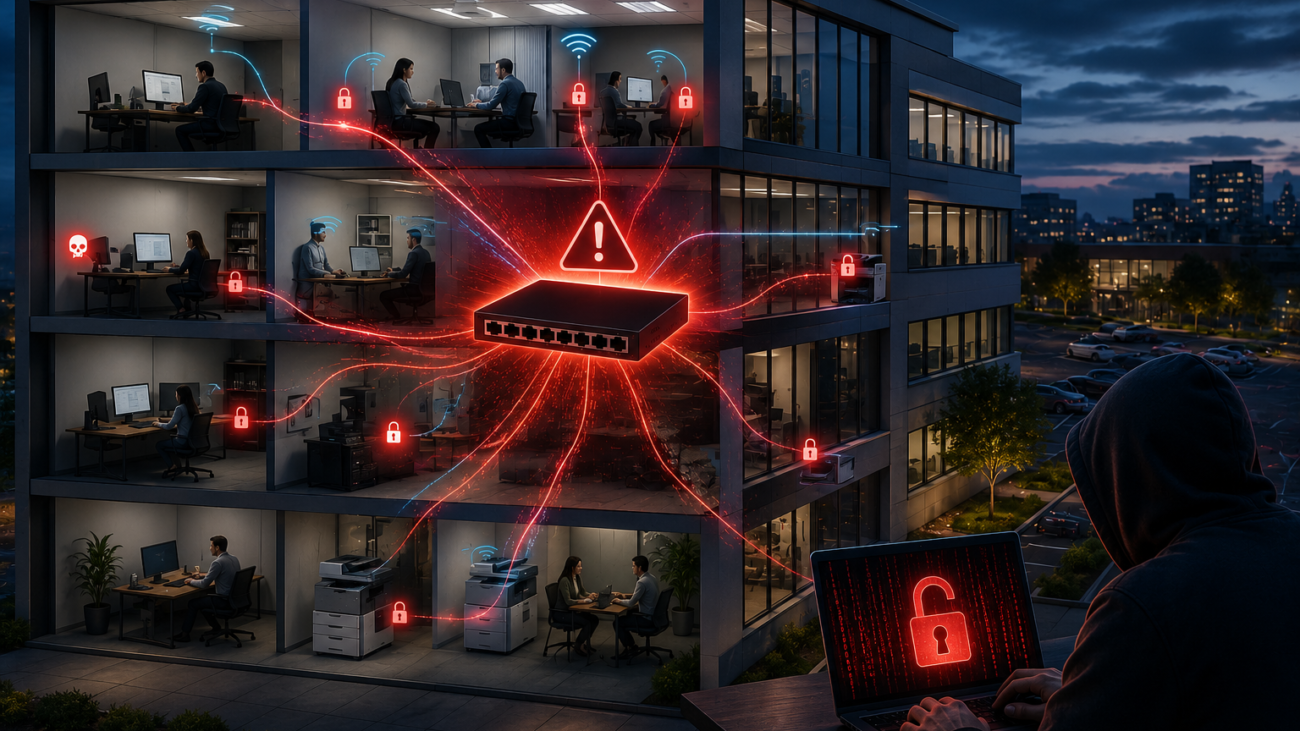
Shared office network security is a growing concern for businesses operating in multi-tenant office buildings. Many companies assume they are protected because their computers work, the internet is fast, and the printer connects without issue. Unfortunately, those assumptions can create significant cybersecurity risks. When multiple businesses share the same network infrastructure without proper security controls, a cyberattack against one tenant can quickly become a cyberattack against everyone.

Across the country, countless office buildings house multiple businesses that share internet connections, networking equipment, and wireless infrastructure. In many cases, building owners provide internet access as an amenity, and tenants simply plug in and get to work.

However, many business owners never realize they may be sharing a network with every other company in the building.

Why One Compromised Computer Can Become Everyone’s Problem

Cybercriminals rarely stop at the first device they compromise.

Instead, once attackers gain access to a computer, they immediately search for other systems on the network. Security professionals call this process lateral movement. During this phase, attackers identify additional computers, servers, printers, network devices, and other connected systems.

Without proper network segmentation and security controls, attackers can potentially:

  • Access computers belonging to other tenants
  • Discover shared files and printers
  • Capture network traffic
  • Harvest usernames and passwords
  • Deploy ransomware across multiple organizations
  • Spread malware throughout the building
  • Disrupt operations for every tenant

As a result, a single employee clicking a malicious email attachment could trigger a cybersecurity incident that affects every company in the building.

“But We’re Not a Target”

Shared Office Network Security

This belief remains one of the most dangerous misconceptions in cybersecurity.

In reality, attackers do not care whether your company has five employees or five thousand employees. Modern cybercriminals use automated tools that continuously scan the internet for vulnerable systems.

Therefore, if your business shares an exposed network with other tenants, your security may only be as strong as the least secure company in the building.

For example, your organization may enforce strong passwords, multifactor authentication, endpoint protection, and security awareness training. Meanwhile, another tenant may operate outdated computers, weak passwords, or no cybersecurity protections at all.

When everyone shares the same network, everyone shares the same risk.

The Liability Question for Building Owners

Building owners and property managers should pay close attention to this issue.

Although liability varies by jurisdiction and contractual agreements, providing internet service without proper network segmentation can create significant legal and financial exposure.

Following a cyber incident, investigators, attorneys, insurance carriers, and affected tenants may ask important questions:

  • Did the building owner implement reasonable security measures?
  • Were tenants informed they shared a network with other businesses?
  • Was network segmentation available but never deployed?
  • Were known cybersecurity risks ignored?
  • Was the network represented as secure when it was not?

Furthermore, if ransomware spreads from one tenant to another because every business operates on the same unrestricted network, investigators will closely examine how the network was designed and managed.

Ultimately, the cost of implementing proper cybersecurity controls is often insignificant compared to the financial, operational, and legal consequences of a major breach.

The Hidden Risk of Sharing a Network with Other Businesses

Shared Office Network Security

Many tenants have no idea they are exposed.

Most business owners focus on serving customers, generating revenue, and managing daily operations. Consequently, they often assume that if the internet works and systems connect properly, everything must be secure.

Unfortunately, functionality and security are not the same thing.

A business may unknowingly share network space with:

  • Insurance agencies
  • Healthcare providers
  • Law firms
  • Financial services companies
  • Collection agencies
  • Retail businesses
  • Contractors
  • Professional service firms

Each organization brings a different level of cybersecurity maturity and risk.

As a result, one compromised system can become a bridge into every other organization connected to the same network.

What Proper Shared Office Network Security Should Look Like

A properly designed business network separates each tenant from every other tenant.

Cybersecurity professionals typically accomplish this through:

  • VLAN segmentation
  • Firewall isolation
  • Network access controls
  • Secure wireless architecture
  • Traffic filtering and monitoring
  • Separate guest and business networks

These controls create barriers between organizations and significantly reduce the likelihood of a compromise spreading across multiple businesses.

Think of it this way: if a fire starts in one apartment, firewalls and barriers help prevent the entire building from burning down.

The same principle applies to cybersecurity.

Why Network Segmentation Matters

Network segmentation serves as one of the most effective defenses in a multi-tenant environment.

Without segmentation, every device on the network may be able to communicate with every other device. Consequently, attackers can move freely between systems once they gain an initial foothold.

With proper segmentation, however, each tenant operates within its own protected environment. Even if one organization experiences a cybersecurity incident, attackers face significant barriers when attempting to reach neighboring businesses.

For this reason, network segmentation should be considered a fundamental component of office building cybersecurity.

Businesses Still Need Their Own Security

Even when a building provides a secure network, each tenant must still protect its own environment.

Therefore, every organization should implement:

  • Endpoint protection
  • Multi-factor authentication
  • Security awareness training
  • Vulnerability management
  • Regular backups
  • Network monitoring
  • Penetration testing

Most importantly, building security and tenant security must work together as layered defenses.

Neither one alone provides sufficient protection.

Don’t Assume Your Shared Office Network Security Is Adequate

If your office is located in a multi-tenant building and you are unsure how the network is configured, now is the time to ask questions.

Ask your building owner or property manager:

  • Who manages the network?
  • Are tenants separated from one another?
  • Can devices belonging to other businesses communicate with our systems?
  • Has the network undergone a network security assessment?
  • What controls protect tenants from each other?

If you do not know the answers, your business may be carrying far more risk than you realize.

At Firma IT Solutions, we help organizations identify hidden weaknesses through network security assessments, penetration testing, and cybersecurity consulting. Before a cybercriminal discovers a weakness in your environment, make sure a trusted cybersecurity professional finds it first.

Contact Firma IT Solutions today at 303-209-0386 to learn how we can help keep your business connected and protected.

CLICK HERE TO REQUEST A PENETRATION TEST QUOTE FOR SERVICE