
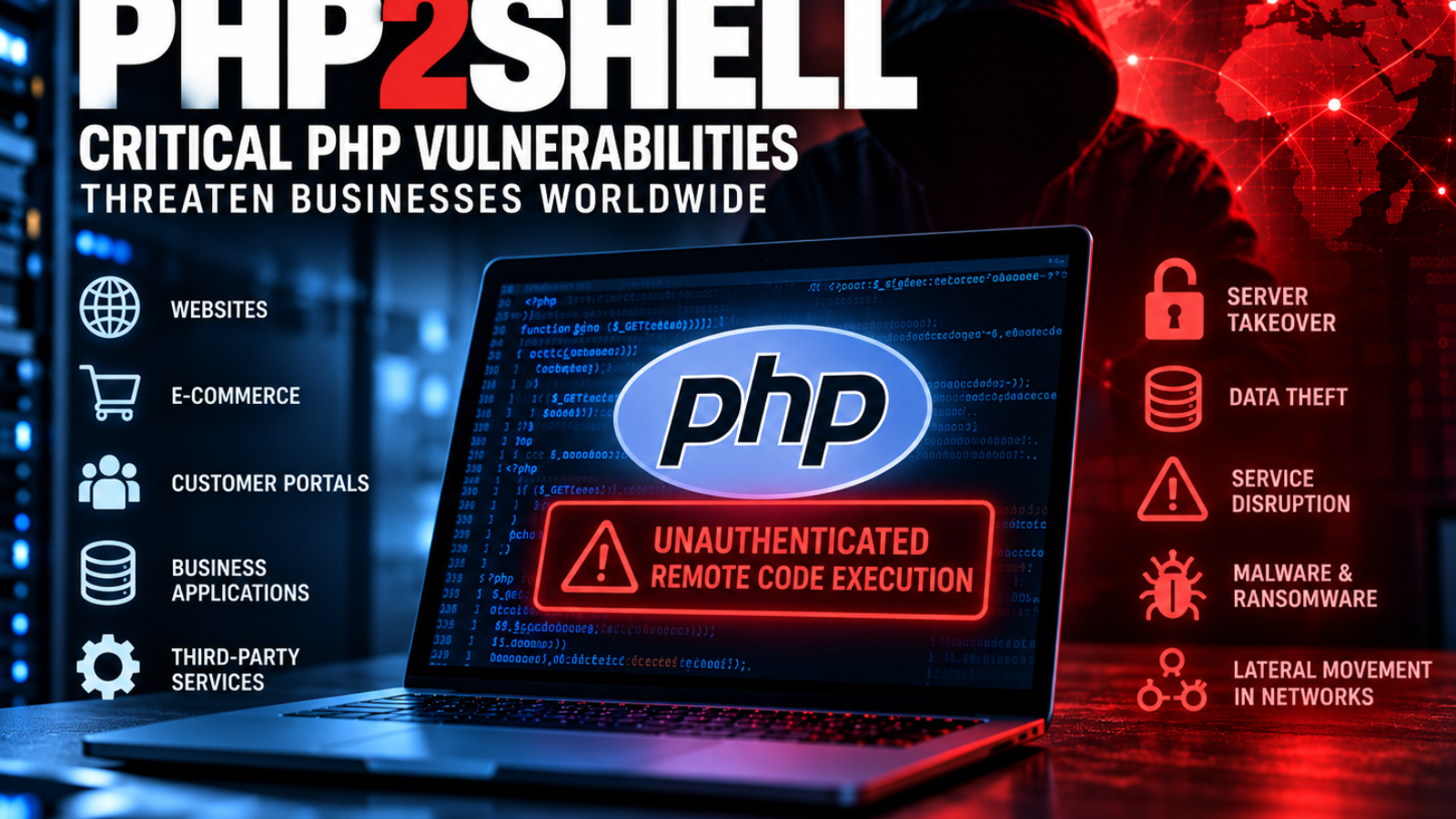
PHP2Shell: Critical Cybersecurity Vulnerabilities Threaten Businesses Worldwide
A critical cybersecurity threat known as PHP2Shell has prompted an urgent warning from the National Security Agency (NSA), raising concerns about the security of millions of websites and business applications worldwide. Two newly disclosed vulnerabilities in PHP, one of the internet’s most widely used programming languages, could allow cybercriminals to take control of vulnerable web servers without requiring a username, password, or prior access.
On October 21, 2026, PHP developers released emergency security patches to address these vulnerabilities. However, businesses that have not updated their systems may remain exposed to potentially devastating cyberattacks.
The NSA has urged organizations to immediately identify vulnerable systems, apply available patches, and increase security monitoring. For businesses that depend on websites, customer portals, and online applications, PHP2Shell represents a serious and immediate cybersecurity risk.
What Is PHP2Shell, and Why Is It Dangerous?
PHP, short for PHP: Hypertext Preprocessor, is a programming language that powers many websites and web applications, including platforms such as WordPress, Drupal, and numerous custom business systems.
PHP2Shell refers to two critical vulnerabilities, CVE-2026-109618 and CVE-2026-109619, both assigned a CVSS severity score of 9.2 out of 10.
These vulnerabilities affect PHP itself rather than a particular website plugin or application. Successful exploitation could allow an attacker to execute malicious commands on a vulnerable server without authentication.
This is especially dangerous because attackers may bypass application-level security controls and gain access to the underlying server environment.
Once inside, cybercriminals could steal confidential information, modify website content, install malware, disrupt services, or attempt to access other systems connected to the compromised server.
What Systems and Businesses Are Affected?
PHP is widely used across healthcare, financial services, education, retail, government, and professional services.
Potentially affected systems include:
- WordPress, Drupal, and other PHP-powered websites.
- E-commerce platforms and online payment applications.
- Customer and patient portals.
- Business management applications and administrative dashboards.
- Web-based APIs and custom applications.
- Third-party software and hosting environments that depend on PHP.
Businesses using Apache, PHP-FPM, and other PHP deployment environments should verify whether their installations are vulnerable.
Importantly, updating a website’s plugins does not necessarily resolve PHP2Shell. The vulnerabilities exist within the PHP runtime, meaning the underlying software must be patched.
Organizations relying on outside hosting companies or software vendors should request confirmation that the appropriate security updates have been installed.
How Serious Is the PHP2Shell Threat?
The potential consequences are significant.
A successful attack could expose customer information, financial records, login credentials, and sensitive business data. Attackers could also deploy ransomware, interrupt online services, or use a compromised server to move deeper into an organization’s network.
For healthcare organizations, this could threaten protected patient information. Financial institutions could face exposure of confidential records, while retailers and professional service providers could experience operational disruptions and reputational damage.
The situation is particularly concerning because publicly available exploit techniques could enable attackers to automate attacks against vulnerable internet-facing systems.
Security reporting has also identified exploitation attempts occurring before the public disclosure of the vulnerabilities.
According to Reuters, some government websites were temporarily taken offline as organizations worked to protect vulnerable infrastructure.
Although the total number of compromised systems and financial losses remains uncertain, the combination of widespread PHP adoption, critical vulnerability severity, and reported exploitation attempts makes PHP2Shell an urgent cybersecurity concern.
What Is the Resolution?
The PHP development team released emergency patches on October 21, 2026.
Organizations should update to the appropriate fixed versions:
| PHP Version | Minimum Patched Release |
|---|---|
| PHP 8.5 | 8.5.12 |
| PHP 8.4 | 8.4.27 |
| PHP 8.3 | 8.3.36 |
| PHP 8.2 | 8.2.35 |
Businesses running older, unsupported PHP versions should migrate to supported releases or obtain verified vendor-supported security updates.
The NSA also recommends temporarily disconnecting vulnerable systems from the internet when immediate patching is not possible and adequate mitigation cannot be implemented.
However, patching alone may not be sufficient if attackers have already compromised a system. Organizations should investigate suspicious activity and verify that unauthorized access has not occurred.
Six Steps Businesses Should Take Immediately
1. Identify vulnerable systems. Conduct an inventory of websites, servers, applications, and third-party services that depend on PHP. Determine which versions are running and whether they are exposed to the internet.
2. Apply emergency patches. Install the latest security updates and confirm that the correct patched versions are running. Request written verification from hosting providers and technology vendors.
3. Conduct vulnerability scanning and penetration testing. Identify exposed systems and evaluate whether attackers could exploit remaining weaknesses. Penetration testing can also reveal security gaps that might allow attackers to access sensitive data or move through internal networks.
4. Increase cybersecurity monitoring. Review web server logs, application activity, unusual network connections, and unauthorized file changes. Enable enhanced logging and security alerts to detect potential exploitation attempts.
5. Isolate systems that cannot be patched. Temporarily remove vulnerable services from internet access when adequate protection cannot be established. Replace unsupported systems that cannot receive security updates.
6. Investigate potential compromises. If suspicious activity is identified, initiate an incident response investigation. Review affected systems, preserve evidence, rotate compromised credentials, and determine whether sensitive information was accessed.
Why Small Businesses Should Pay Attention
Many small and medium-sized businesses depend on third-party web developers, hosting companies, and IT providers to maintain their technology infrastructure.
Unfortunately, business owners may not know which PHP versions their websites use or whether security patches are being applied.
A website can appear to function normally while remaining vulnerable to attack.
PHP2Shell reinforces the importance of proactive cybersecurity practices, including vulnerability management, regular penetration testing, managed IT services, and documented incident response procedures.
Cybersecurity is not simply about keeping technology operational. It is about protecting the information, systems, and customer relationships that businesses depend upon.
How Firma IT Solutions Can Help
At Firma IT Solutions & Services, we help businesses identify cybersecurity vulnerabilities before attackers can exploit them.
Our penetration testing and managed IT services help organizations evaluate internet-facing infrastructure, identify weaknesses, prioritize security improvements, and strengthen their overall cybersecurity posture.
PHP2Shell demonstrates why businesses cannot afford to wait until a breach occurs before addressing cybersecurity risks.
The most important question is not whether your business uses PHP. It is whether someone has verified that your systems are protected.
Protect your business before cybercriminals find an opportunity.
Firma IT Solutions & Services — Keeps You Connected and Protected.
Website: www.firmaitss.com
Phone: 303-209-0386
Email: admin@firmaitss.com
