



Shared Office Network Security: The Hidden Cybersecurity Threat Lurking Inside Multi-Tenant Office Buildings
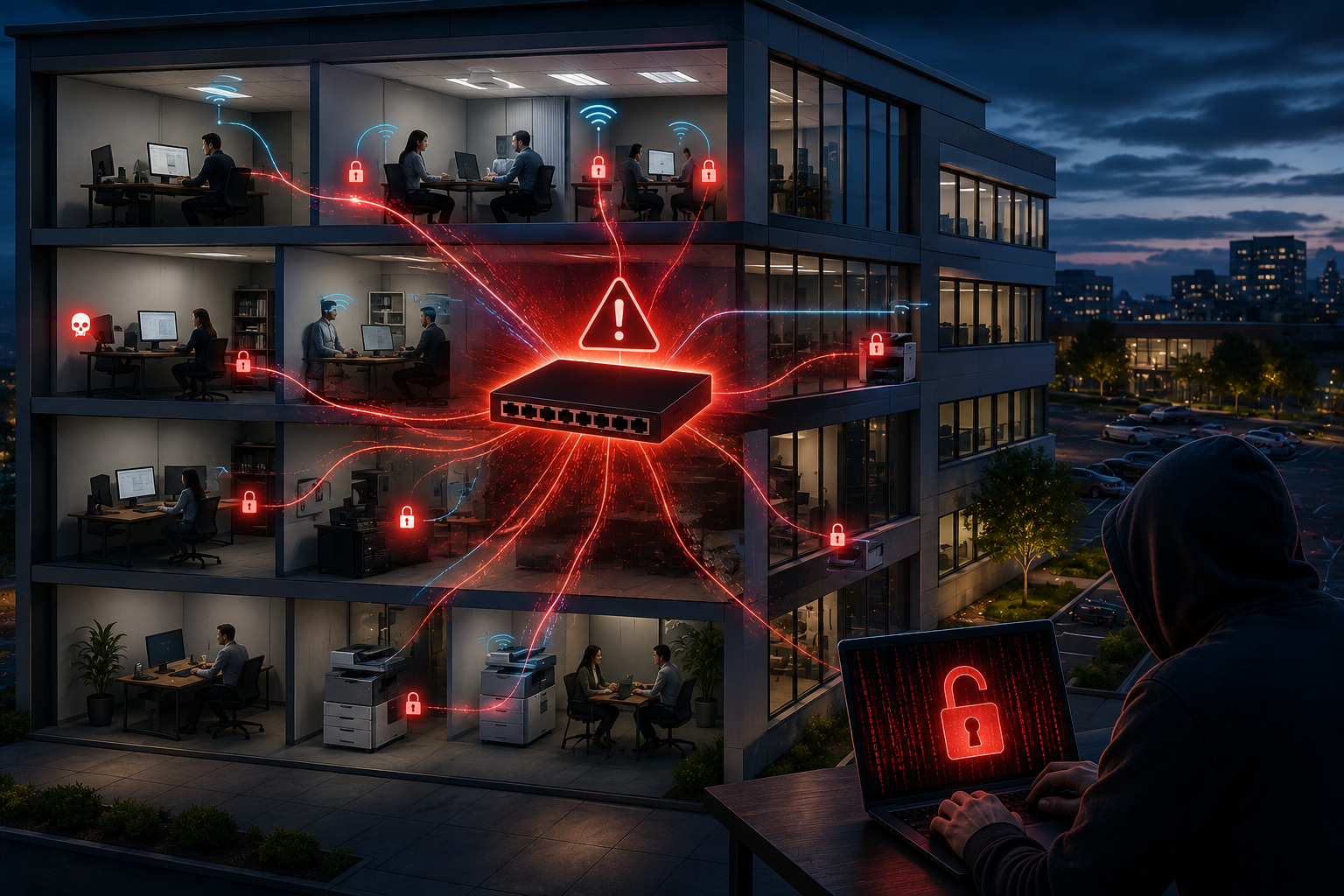
Shared office network security is a growing concern for businesses operating in multi-tenant office buildings. Many companies assume they are protected because their computers work, the internet is fast, and the printer connects without issue. Unfortunately, those assumptions can create significant cybersecurity risks. When multiple businesses share the same network infrastructure without proper security controls, a cyberattack against one tenant can quickly become a cyberattack against everyone.
Across the country, countless office buildings house multiple businesses that share internet connections, networking equipment, and wireless infrastructure. In many cases, building owners provide internet access as an amenity, and tenants simply plug in and get to work.
However, many business owners never realize they may be sharing a network with every other company in the building.
Why One Compromised Computer Can Become Everyone’s Problem
Cybercriminals rarely stop at the first device they compromise.
Instead, once attackers gain access to a computer, they immediately search for other systems on the network. Security professionals call this process lateral movement. During this phase, attackers identify additional computers, servers, printers, network devices, and other connected systems.
Without proper network segmentation and security controls, attackers can potentially:
- Access computers belonging to other tenants
- Discover shared files and printers
- Capture network traffic
- Harvest usernames and passwords
- Deploy ransomware across multiple organizations
- Spread malware throughout the building
- Disrupt operations for every tenant
As a result, a single employee clicking a malicious email attachment could trigger a cybersecurity incident that affects every company in the building.
“But We’re Not a Target”

This belief remains one of the most dangerous misconceptions in cybersecurity.
In reality, attackers do not care whether your company has five employees or five thousand employees. Modern cybercriminals use automated tools that continuously scan the internet for vulnerable systems.
Therefore, if your business shares an exposed network with other tenants, your security may only be as strong as the least secure company in the building.
For example, your organization may enforce strong passwords, multifactor authentication, endpoint protection, and security awareness training. Meanwhile, another tenant may operate outdated computers, weak passwords, or no cybersecurity protections at all.
When everyone shares the same network, everyone shares the same risk.
The Liability Question for Building Owners
Building owners and property managers should pay close attention to this issue.
Although liability varies by jurisdiction and contractual agreements, providing internet service without proper network segmentation can create significant legal and financial exposure.
Following a cyber incident, investigators, attorneys, insurance carriers, and affected tenants may ask important questions:
- Did the building owner implement reasonable security measures?
- Were tenants informed they shared a network with other businesses?
- Was network segmentation available but never deployed?
- Were known cybersecurity risks ignored?
- Was the network represented as secure when it was not?
Furthermore, if ransomware spreads from one tenant to another because every business operates on the same unrestricted network, investigators will closely examine how the network was designed and managed.
Ultimately, the cost of implementing proper cybersecurity controls is often insignificant compared to the financial, operational, and legal consequences of a major breach.
The Hidden Risk of Sharing a Network with Other Businesses

Many tenants have no idea they are exposed.
Most business owners focus on serving customers, generating revenue, and managing daily operations. Consequently, they often assume that if the internet works and systems connect properly, everything must be secure.
Unfortunately, functionality and security are not the same thing.
A business may unknowingly share network space with:
- Insurance agencies
- Healthcare providers
- Law firms
- Financial services companies
- Collection agencies
- Retail businesses
- Contractors
- Professional service firms
Each organization brings a different level of cybersecurity maturity and risk.
As a result, one compromised system can become a bridge into every other organization connected to the same network.
What Proper Shared Office Network Security Should Look Like
A properly designed business network separates each tenant from every other tenant.
Cybersecurity professionals typically accomplish this through:
- VLAN segmentation
- Firewall isolation
- Network access controls
- Secure wireless architecture
- Traffic filtering and monitoring
- Separate guest and business networks
These controls create barriers between organizations and significantly reduce the likelihood of a compromise spreading across multiple businesses.
Think of it this way: if a fire starts in one apartment, firewalls and barriers help prevent the entire building from burning down.
The same principle applies to cybersecurity.
Why Network Segmentation Matters
Network segmentation serves as one of the most effective defenses in a multi-tenant environment.
Without segmentation, every device on the network may be able to communicate with every other device. Consequently, attackers can move freely between systems once they gain an initial foothold.
With proper segmentation, however, each tenant operates within its own protected environment. Even if one organization experiences a cybersecurity incident, attackers face significant barriers when attempting to reach neighboring businesses.
For this reason, network segmentation should be considered a fundamental component of office building cybersecurity.
Businesses Still Need Their Own Security
Even when a building provides a secure network, each tenant must still protect its own environment.
Therefore, every organization should implement:
- Endpoint protection
- Multi-factor authentication
- Security awareness training
- Vulnerability management
- Regular backups
- Network monitoring
- Penetration testing
Most importantly, building security and tenant security must work together as layered defenses.
Neither one alone provides sufficient protection.
Don’t Assume Your Shared Office Network Security Is Adequate
If your office is located in a multi-tenant building and you are unsure how the network is configured, now is the time to ask questions.
Ask your building owner or property manager:
- Who manages the network?
- Are tenants separated from one another?
- Can devices belonging to other businesses communicate with our systems?
- Has the network undergone a network security assessment?
- What controls protect tenants from each other?
If you do not know the answers, your business may be carrying far more risk than you realize.
At Firma IT Solutions, we help organizations identify hidden weaknesses through network security assessments, penetration testing, and cybersecurity consulting. Before a cybercriminal discovers a weakness in your environment, make sure a trusted cybersecurity professional finds it first.
Contact Firma IT Solutions today at 303-209-0386 to learn how we can help keep your business connected and protected.